













NHF Digital Edition

Get our FREE digital edition! Subscribe here.

Feed Alternatives Not A Quick Nutritional Fix

Weigh the pros and cons before adding feed by-products to swine rations.

Producers often get excited when they locate a source of feed alternatives at a reasonable price. But Joel DeRouchey says there's a lot to be considered before locking in a load.

Many producers are scouring sources to save on high-priced corn and soybean meal. However, the first step should be to check the quality consistency of the shipment, then whether future shipments will likely be uniform in quality over time.

“Getting spot loads can help over a short period, but if logistical and quality concerns are present, it may not do you a lot of good,” surmises DeRouchey, Kansas State University.

Will Alternatives Work?

Most corn and soybean meal-based diets use a digestible amino acid base for formulating diets. With data lacking on digestibility for some alternative feed ingredients, producers and nutritionists may have to estimate those values or formulate on a total amino acid basis, DeRouchey says.

Distiller's dried grains with solubles (DDGS) is a good example of an alternative feedstuff with variations in digestibility. Data for DDGS in 2006 from Hans Stein of the University of Illinois shows a range in digestibility from 43.9 to 63%. That is a huge range that changes diet formulation and the amount of extra soybean meal required to balance that mixed swine ration, he continues.

A 2008 update from Stein showed a range in variability of 60.3 to 67.4% for DDGS, a much tighter range, but still presented some concern for variability.

“Variability occurs in other alternatives as well, so we have to have good values and some confidence in that plant, yet understand that some days' loads are going to be better and some days' loads are going to be worse,” he says.

Dietary energy levels must be monitored closely, even as the industry moves to increased use of alternative ingredients with more fiber in order to keep rations balanced and feed efficiency and performance equal.

Again, DeRouchey reminds producers that DDGS compares closely to corn in terms of energy level. Other alternative ingredients with lower energy concentrations may require added fat to maintain equal growth performance. However, it can be more economical to feed a lower energy diet and have decreased performance.

Overall feed costs can also increase when “cheap” alternative ingredients suddenly become popular and the price advantage is lost. “Along with availability, continued economic advantage must be realized. Sudden increases in demand for a lower-priced alternative may drive prices up, making the new product uneconomical in a short period of time,” he warns.

Even if feed alternatives appear advantageous, introducing a new alternative may be impractical if adding bin space is cost prohibitive.

Here's a quick rundown on some positive and negative aspects of feed alternatives:

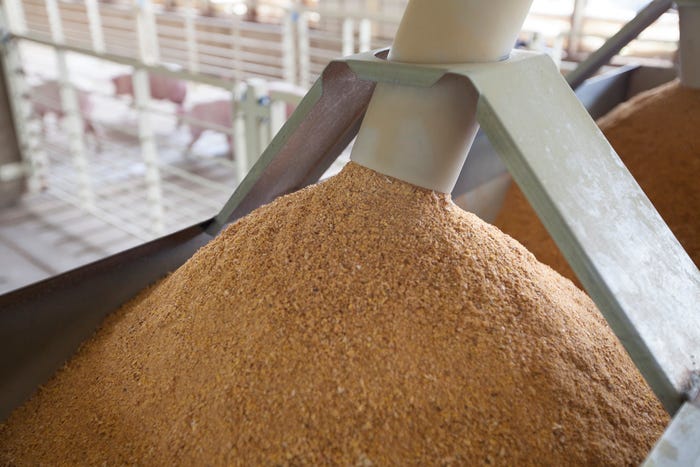
  • DDGS: This by-product can replace part of the corn in the swine diet as an energy source, giving it an advantage over many other alternatives. DDGS also provides 3-4 times the availability of phosphorus in corn.

    In general, DDGS can be fed up to 30% in a grow-finish diet, but growth rates in finishing can suffer at levels greater than 20%. Sow gestation diets generally range from 20-30% DDGS; the usual rule is to feed half the amount of DDGS in lactation that is fed in gestation rations.

    Watch DDGS for mycotoxins, especially in sow diets. Avoid buying DDGS from regions where corn is stressed during the growing season, which may produce mycotoxins.

    “One thing we do know about feeding distiller's is that carcass quality is affected,” DeRouchey states. “For every 10% distiller's we feed, we expect to see carcass yield go down by 0.4%, so feeding 20-30% distiller's can be a highly significant loss of revenue.

    “However, a decrease in feeding levels prior to market can help offset this effect. In reality, most producers who feed up to 30% distiller's drop down to 10-15% in the last one or two diet phases in finishing, mitigating the yield effect,” he adds.

    Assuming no difference in pig performance, you can afford to pay more for DDGS than corn because it is worth more due to the replacement of dietary soybean meal and added phosphorus, DeRouchey remarks.

  • Wheat middlings: About 20-25% of wheat by-products, including wheat midds, remain after processed flour is extracted from wheat.

    Wheat midds feature higher protein content than corn, higher phosphorus and better phosphorus digestibility than corn.

Previous Page: Diet Calculators Available

Want to use this article? Click here for options!
© 2010 Penton Media Inc.


Most Recent Story

Most Recent Articles


National Hog Farmer TV

Resources

  • Industry Resources
  • Calendar
  • Blueprint Issues
  • Career Opportunities
  • Pork Checkoff
  • Quarterly/Weekly Hog and Pig Reports
  • Product Info
  • People
  • Production Posters
  • Green Agriculture
  • State of the Pork Industry Report
  • New Product Tour

Current Issue

More Federal Market Oversight Likely

Friday's USDA/Department of Justice "Competition in Agriculture Workshop," held in Ankeny, IA, was long on rhetoric, but surprisingly balanced regarding substantive issues. A wide range of opinions were expressed and the proceedings were far more orderly than most expected.

More Gilt Management Tips to Improve Breeding Herd Performance

In addition to the number of recorded heat cycles before breeding and the gilt’s exposure to gestation stalls before breeding, there are additional management factors that affect gilt performance. Following are a few additional considerations:

Marketplace Ads

  • VAL-CO

    Swine Heat Stress. Start thinking about your summer cooling options.

  • Advertise in our Marketplace

    Advertise your business here! Find out how.

  • U.S. Crop and Livestock Maps for sale

    Ag Maps for Sale: U.S. Crop and Livestock Maps

Back Issues Archive