















The Right Diet At the Right Time
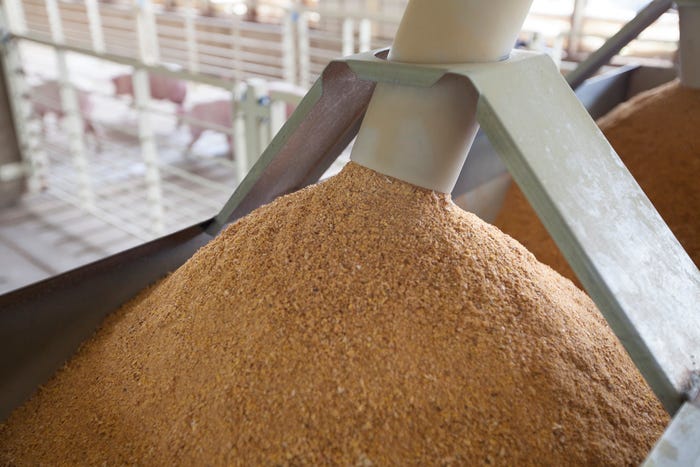
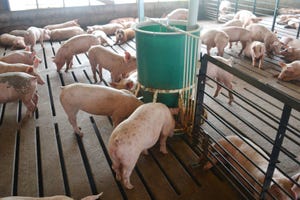
Diet formulation and feeding programs — traditionally formulated for group averages — short suits the lighter pigs and overfeeds the heavies.
Previous Page: Nursery Application
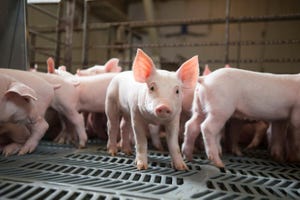
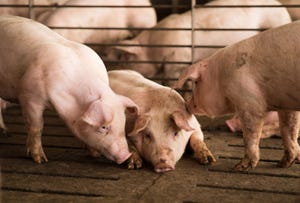
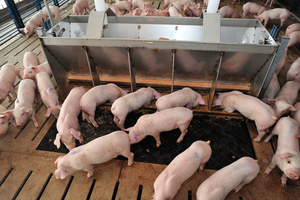
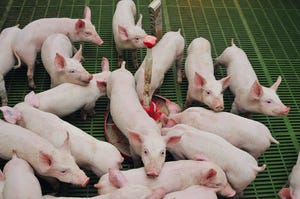
“The most obvious thing is I can help the little pigs — the lights. Typically, you feed for the middle of the road, so the big ones get overfed and the small ones fall further behind. Those little pigs will do just fine if you get them on the right feed, early on, and you give them a little more of it,” he explains.
Schaefer estimates he saves 75 cents to $1/pig/turn. With each of the 1,000-head nursery rooms turned eight times per year, the net savings could be up to $16,000 annually. His feed costs are calculated on $3.50/bu. corn and $310 soybean meal, admittedly a little high, “but they're my actual costs,” he explains. “Any way you figure it, 60-70% of the cost of raising a pig is feed, so anything you can do to lower those costs is worthwhile.
“And, I think we will pick up more savings in the finisher because the nursery pigs are more even going in,” he says. The first set of the FeedSaver-fed nursery pigs were being closed out in a nearby finisher in mid-May. “I think we will have just seven light pigs in the 800-head barn,” he says. “I think I can take a week off of the tail-enders pretty easily by getting the light pigs caught up in the nursery. Everyone talks about barn utilization and evening out groups and I think we are accomplishing that pretty well.”
Five-turn Summary
Schaefer is particularly impressed by how quickly feed cost/lb. of gain can be calculated when a nursery room is closed out. The five-turn summary (Table 4) shows daily gain performance at or near 1 lb./day, which he attributes in part to feeding the lighter pigs better. “Any time you get close to a pound of gain per day — and you can do it in about 40 days — it's pretty good, particularly when most pigs gain about 0.85 lb./day in 50 days. That's about where we were before,” he explains. “My Land O'Lakes nutritionist tells me these closeouts are in the top 10% of the numbers they see.”
He gives some credit for the improved nursery performance to his switch to batch farrowing, which has given him healthier pigs vs. the co-mingled pigs placed previously.
Schaefer is anticipating a two-year payback on his investment. “Instead of getting bigger and bigger, I would just as soon get the best out of everything I've got,” he says. “You can't argue with the concept — it's the right way to feed pigs.”
Drew Ryder, product manager at Feed Logic Corporation, says a FeedSaver-M series unit installed in a 2,000-head nursery comparable to Schaefer's would cost about $34,000 today. A FeedSaver-S series, with feed blending capabilities similar to the Thomes' 2,400-head, grow-finish unit, would bid out at roughly $21,000. Additional operational and contact information is available.
Want to use this article? Click here for options!
© 2009 Penton Media Inc.