NHF Digital Edition

Get our FREE digital edition! Subscribe here.

The Right Diet At the Right Time

Diet formulation and feeding programs — traditionally formulated for group averages — short suits the lighter pigs and overfeeds the heavies.

Previous Page: First Closeout

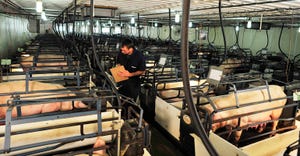
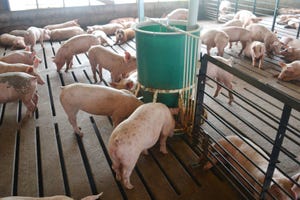
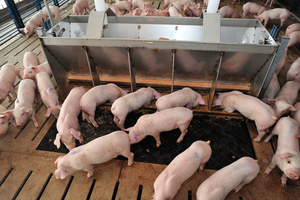
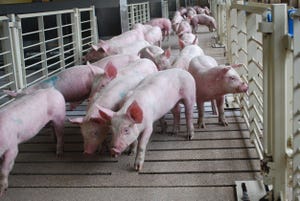
Typically, there are 150-200 pigs/pen in the large-pen area. If a feeder plugs or if Matt turns feeders off to check them — which he does a couple of times during each turn — the pigs leave those pens.

And, because there are essentially no aisles in the barn, “You have to walk the pens to check feeders and waterers, so the pigs get used to you,” Matt explains.

The large pens seem to suit the pigs, too. “From a pig comfort and pig welfare standpoint, there's next to no tail biting and lameness. Pigs don't get picked on or beat up because they can leave a pen anytime they want,” he adds.

“I think feed cost is the biggest issue we face,” adds Gary Thome. “Looking long term, if we can have a feed savings of 1.5 cents/lb., which some Australian work shows, and if average gain is 200 lb./pig, that's $2.50-3.00/pig — a realistic goal.

“Another advantage we have is we're a family operation and I feel very comfortable that we've got the management and expertise to get the most out of this system. With the way the industry is headed, one of the strategic advantages we have is management, so we need to capitalize on that,” he adds.

Nursery Application

Mark Schaefer, Taopi, MN, owner and manager of an 850-sow, farrow-to-finish operation, has completed six turns in a pair of 1,000-head nursery rooms equipped with a Feedlogic FeedSaver M (mobile) series system.

Of the six turns, Schaefer has data summarized on five. Table 2 summarizes the Turn #5 closeout.

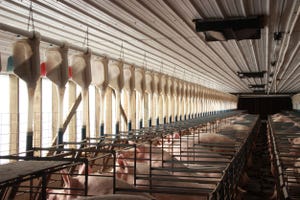
The M-series differs in that it features a fixed rail mounted to the room's ceiling. A self-propelled feed hopper rides the rail and stops over each feeder, positioned by sensors mounted in the ceiling.

From the central computer bay positioned at the end of a hallway dividing the nursery rooms, Schaefer easily accesses two software modules. The control module allows him to manage and monitor the system. A customized virtual barn view displays the pen layout in each room, which allows him to manage the diet, time and frequency of feed delivery. A data module generates reports on feeding activities and tracks the diets offered. A wide area network (WAN) provides off-site access to the on-site, wireless network.

As each room is loaded, pigs are sorted by sex and into three categories — lights, standards and heavies. With a 20-pen diagrammed worksheet in hand, he goes to the computer and clicks on each pen in the virtual layout, placing it in one of the three categories.

The feed consumption curve is developed with the assistance of a Land O'Lakes swine nutritionist, tailoring it to the herd's typical feed consumption during the nursery stage with a little tweaking for genetics changes, as needed. Once placed on the curve, the pigs progressively move through three primary diets, transitioning from one to the next as they meet respective benchmark weights.

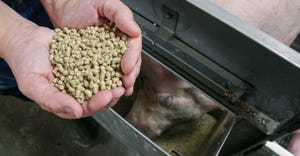
“The feeding curve is preset, so all I have to decide is which curve to start them on,” Schaefer explains. “In turn #5, the heavies get 1.0 lb., the standards get 1.2 lb., and the lights get 1.8 lb. of the pelleted diet (Table 3). “When they move to the transition (second) diet, the heavies get 3 lb., the standards get 4.2 lb. and the lights get 5.1 lb. of the grind-and-mix diet.”

Occasionally, a pen of extra light pigs is placed in the nursery, so the feeding system is programmed to skip their pen feeder so Schaefer can bag feed Land O'Lakes' Ultra Care pellets for 3-4 days before placing them on the feed consumption curve.

“The thing I watch the closest is making sure the pigs weigh at least 15 lb. before they move onto the transition diet,” he notes. This is accomplished by hand-weighing a few pigs in a pen to ensure they've reached the target weight. The procedure is repeated as pig weights approach 20 lb., the step in the feeding curve where each pig receives about 7 lb. of “high” blend.

The steps that follow continue along the curve, with the next blend being 90% high/10% low diet, then 80/20, 70/30 and so on until the last 10 days in the nursery when pigs receive 100% of low blend diet.

Feed, Pig Management

From 20-40 lb., the pigs are on high-low diet blends, but after 40 lb., they receive the low blend exclusively. Schaefer pulls out the nursery closeout sheet for the fifth turn on the FeedSaver system to illustrate a point: “The difference in costs between the high and low diets is $189/ton. The quicker I can get them switched over, the better,” he notes.

Next Page: Five-turn Summary

Want to use this article? Click here for options!
© 2009 Penton Media Inc.


Most Recent Story


Most Recent Articles


National Hog Farmer TV

Resources

  • Industry Resources
  • Calendar
  • Blueprint Issues
  • Career Opportunities
  • Pork Checkoff
  • Quarterly/Weekly Hog and Pig Reports
  • Product Info
  • People
  • Production Posters
  • Green Agriculture
  • State of the Pork Industry Report
  • New Product Tour

Current Issue

New Rules for Risk Management

Risk management, it seems, has always been viewed favorably by pork producers. Problem is, it's rarely practiced to any great degree. ...

Current Issue

"Swine Flu" - It's Time to Move On

Something bad has happened to you. It wasn't deserved and it wasn't fair. The people who did it are callous and heartless (at least in regard to you), and lazy, or they would not have done it. But they did it. It's over. It's done. You can whine and wallow in self-pity and martyrdom or pick yourself up, dust yourself off and get on with life and the business of raising quality pork. ...

Marketplace Ads

  • VAL-CO

    Swine Heat Stress. Start thinking about your summer cooling options.

  • Advertise in our Marketplace

    Advertise your business here! Find out how.

  • U.S. Crop and Livestock Maps for sale

    Ag Maps for Sale: U.S. Crop and Livestock Maps

Back Issues Archive