NHF Digital Edition

Get our FREE digital edition! Subscribe here.

Skip the Sorting

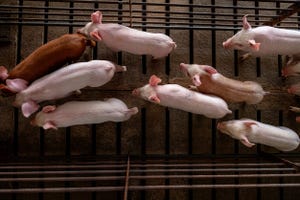
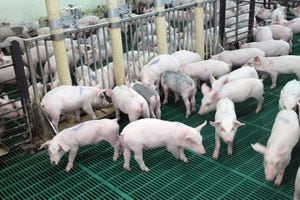
Sorting pigs by weight when stocking a grower-feeder barn is a waste of time, says researcher.

A trial conducted by research scientist Harold Gonyou at the Prairie Swine Centre, Saskatoon, Saskatchewan, shows the performance of non-sorted pigs was as good, if not better, than pigs sorted into three groups — heavy, middle and light.

Gonyou found no advantage in sorting pigs in continuous-flow management systems, and it actually slowed development in all-in, all-out (AIAO) systems.

Average daily gain (ADG) and behavior did not differ between pigs in weight-balanced pens vs. variable-weight pens. However, the rate that pens and rooms were emptied differed depending on grouping strategy and pig flow management.

“Under a continuous-flow system, pens were emptied in an average of 105.5 days, while under an AIAO system the rooms were emptied in an average of 107.5 days,” Gonyou reports. “Uniform and variable-weight pens emptied at the same rate under the continuous-flow system. Under the AIAO system, rooms of variable-weight pens emptied faster (104.1 days) than did rooms of uniform-weight pens (110.9).

The practice of sorting pigs by size has a long history, dating back to when pigs were commonly fed fixed amounts of feed several times a day.

“When you were limit feeding your pigs, you created a very competitive situation,” Gonyou says. “If you had small pigs in a pen, they tended to fall farther and farther behind.”

Today, pigs in most grow/finish systems in North America can obtain as much feed and water as they want. There is no reason for a dominant pig to defend food and water resources. As long as pigs are able to obtain adequate amounts of feed, dominant pigs appear to adopt a strategy of eating more quickly rather than increasing their defense of the feeder, he explains.

“By taking away competition for feed or water in our pens, we've created a different social situation,” Gonyou says. He believes that sorting pigs stresses the animals until they can find their place in the pen's social pecking order. In unsorted pens, small pigs know they have to defer to larger pigs. There is no need for conflict. However, when they have similar physical attributes — same size, same strength, etc. they become more competitive.

“If you put two pigs together that are within a kilogram (2.2 lb.) in weight, their fights are longer than if you put two pigs together that are 3 kg (10 lb.) apart,” Gonyou says. “If you are close to the weight of another pig, you might lose the first fight. But, two or three weeks later, you might try it again. If you're a small pig, you are not going to get involved in a fight with a big pig and always lose.”

Therefore, weight diversity helps maintain social status and stability in the pens. “Our thought was that if we didn't sort pigs, would we see a reduction of the social stress that happens within a pen and that would be manifested in performance differences,” Gonyou says. “In fact, that's what we find when we are dealing with unsorted pigs that are relatively similar in age, within a couple of weeks of each other.”

Behavior Test, Too

Gonyou also examined whether it made sense to sort pigs by behavioral or personality characteristics. Pigs were divided into one of three groups — aggressive, non-aggressive and a mixture of the two.

“We found that if we put the aggressive pigs together in a pen with just other aggressive pigs, then their productivity was depressed,” Gonyou says. “If we put all the non-aggressive pigs together in a pen, they had good productivity. And, if there was a mixture of aggressive and non-aggressive pigs in a pen, they had good productivity as well.

“You can overcome bad productivity among aggressive pigs by mixing them with non-aggressive pigs. So this study again shows that having diversity or variation within a pen is beneficial to the social hierarchy or the social attitude within that group of animals,” he concludes.

In short, the study shows that it takes all types of pigs to have a productive social structure. Diversity is a good thing if resources are abundant.

“The bottom line is that we probably waste our effort if we spend a lot of time sorting pigs according to body weight when they're going into the grower-finisher barn,” Gonyou says. “I think it's more important to have animals that are fairly close together in age, simply because they'll finish out at the same time.”

Want to use this article? Click here for options!
© 2009 Penton Media Inc.


Most Recent Story


Most Recent Articles


National Hog Farmer TV

Resources

  • Industry Resources
  • Calendar
  • Blueprint Issues
  • Career Opportunities
  • Pork Checkoff
  • Quarterly/Weekly Hog and Pig Reports
  • Product Info
  • People
  • Production Posters
  • Green Agriculture
  • State of the Pork Industry Report
  • New Product Tour

Current Issue

Costs, Price Pressures Ease Just a Little

There was a lot to be positive about in the pork industry the last week of October. I realize it is difficult to be optimistic when you are still losing $25 to $30/head. I also realize that positive news at this point could be as dangerous as it is welcome. But facts are facts, and we must recognize them. ...

Current Issue

The "Good" and "Bad" Sides of a Cheaper Dollar

As I begin this week's column, I"m reminded of two different "flip side" statements that may help characterize the topic at hand. The first is the old Archie Campbell schtick - "That's good - no that’s bad," which I have used before. The second reflects President Truman's frustration with economists' incessant use of the qualifier - "on the other hand" - to introduce the contrary opinion on a given topic. President Truman once demanded in his usual colorful language: "Will someone please find me a *!&%$*?>

Marketplace Ads

  • VAL-CO

    Swine Heat Stress. Start thinking about your summer cooling options.

  • Advertise in our Marketplace

    Advertise your business here! Find out how.

  • U.S. Crop and Livestock Maps for sale

    Ag Maps for Sale: U.S. Crop and Livestock Maps

Back Issues Archive