(Editor's note: Table 1 accompanying this research report, National Hog Farmer, Dec. 15, 2002, p. 18, was incorrect. Following is the complete report and correct table.)
Louisiana State University (LSU) Agricultural Center researchers recently discovered microbial phytase supplementation could replace added trace mineral premixes in nursery pig diets.
The primary reason phytase is added to swine diets is to help increase phosphorus availability and to reduce the amount of phosphorus excreted in feces.
The researchers say adding phytase to corn-soybean meal diets can increase the availability of calcium, phosphorus, energy and amino acids. In addition, phytase has been shown to increase the availability of some trace minerals, including copper, manganese, iron and zinc.
Researchers speculate the effect of phytase on trace minerals may mean trace minerals could be removed from diets when phytase is added.
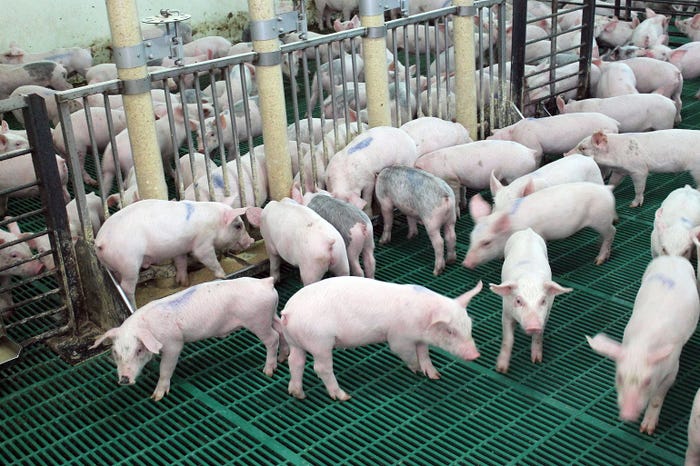
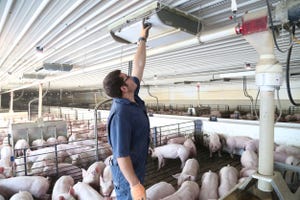
The LSU research was conducted with 208 crossbred barrows and gilts, weaned at 21 days of age and fed four different diets.
Pigs were fed a conventional nursery diet with trace mineral premix (control diet), conventional nursery diet without trace mineral premix (- Mineral), control with microbial phytase (+ Phytase), or control with phytase but without trace mineral premix (-Minerals, + Phytase). See Table 1.
Average daily gain (ADG), average daily feed intake (ADFI) and gain:feed were measured at the end of Phase 1 (7 days), Phase 2 (14 days) and Phase 3 (13 days).
Researchers found pigs fed the conventional nursery diet without the trace mineral premix had decreased growth performance. However, pigs fed the same diet, but with supplementation of phytase, had growth performance equal to that of the pigs fed the control diet. Pigs fed the diet without the trace minerals returned to normal growth after they were fed the control diet for two weeks.
Table 1 shows the effects of the experimental diets on growth performance during the nursery phase.
Skin lesions developed on 26 of the 52 pigs fed the conventional nursery diet without the trace mineral premix. No lesions were found on any of the pigs fed the diets with the trace mineral premix or with the addition of phytase. The skin lesions were healed on all pigs after five weeks of being fed the control diet.
Researchers: Jason Shelton, L. Lee Southern, and Tom Bidner. Contact L. Lee Southern at (225) 578-3449, or e-mail lsouthern@agctr.lsu.edu.
| Item | Control | +Phytase | -Minerals | -Minerals +Phytase | |
|---|---|---|---|---|---|
| Phase 1 (0 - 7 d) | |||||
| ADG, g. | 122 | 141 | 141 | 150 | |
| ADFI, g. | 177 | 195 | 211 | 211 | |
| Gain:feed, g./kg.e | 664 | 725 | 667 | 692 | |
| Phase 2 (8 - 21 d) | |||||
| ADG, g.b | 345 | 342 | 292 | 323 | |
| ADFI, g.b,c,d | 538 | 539 | 462 | 546 | |
| Gain:feed, g./kg. | 641 | 635 | 626 | 603 | |
| Phase 3 (22 - 34 d) | |||||
| ADG, g.b,c,d | 457 | 440 | 339 | 468 | |
| ADFI, g.b,c,d | 812 | 819 | 609 | 819 | |
| Gain:feed, g./kg. | 566 | 540 | 551 | 573 | |
| Overall (0 - 34 d) | |||||
| ADG, g.b,c,d | 342 | 338 | 277 | 350 | |
| ADFI, g.b,c,d | 585 | 576 | 467 | 577 | |
| Gain:feed, g./kg. | 584 | 587 | 590 | 607 | |
| aData are means of eight replicates of six pigs per replicate. Average initial and final bodyweight were 5.4 and 15.9 kg. for the gilts and 5.6 and 16.4 kg. for the barrows, respectively. | |||||
| bMineral, P<0.05. | e1kg.=2.2 lb. | ||||
| cPhytase, P<0.02. | ADG=average daily gain | ||||
| dPhytase × mineral, P <0.02. | ADFI=average daily feed intake | ||||