NHF Digital Edition

Get our FREE digital edition! Subscribe here.

New Clostridium Claiming Baby Pigs

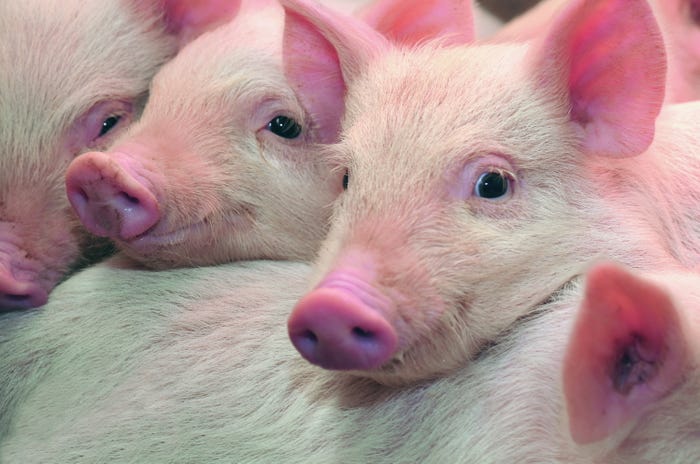
Pigs up to 10 days of age show a yellow, pasty diarrhea, says Karen Post, DVM, a bacteriologist at the Raleigh, NC, laboratory. Up to 55% of the enteritis cases involve the organism as a co-conspirator, which can trigger a higher mortality rate.

Usually pigs aren't nursing well and appear gaunt. At necropsy, a hallmark of the disease is edema of the mesentery — the membrane holding the colon. C. difficile is often cultured with Clostridium perfringens (C. perfringens), type A.

“Unless you're looking for difficile, you're not going to find it,” Post notes. “We had a lot of undiagnosed cases of neonatal enteritis in North Carolina before 1998. Then reports from Canada on sudden deaths in large farrowing houses found C. difficile. We've been finding it here ever since.”

Glenn Songer, University of Arizona department of veterinary science, is one of Post's collaborators in ongoing studies of the organism. Songer says C. difficile is sweeping the industry, with diagnoses increasing in Iowa, Minnesota, Indiana, Colorado, Texas, in addition to North Carolina, plus Canadian provinces Saskatchewan and Ontario.

Epidemiological studies are underway to identify risk factors, which includes antibiotic treatment in humans, horses and hamsters. Researchers believe giving penicillins or cephalosporins to pigs at processing may pose a risk factor. Third-generation penicillins have been linked to difficile in humans and laboratory animals.

Treatments in other species involve antibiotics not approved for food animals. Songer and Post are doing laboratory tests to determine if common antibiotics are effective against difficile.

Vulnerable Preweaned Pigs

The biggest problem with the organism is its effect on pig size. “Survivors are stunted so weights are lower at weaning,” observes Richard Conger, a veterinarian in Goldsboro, NC. “Toxins destroy the intestinal lining, which takes weeks to heal. By then pigs are weaned and into the nursery. They usually end up in the runt pen and get lost in the system.”

Mortality rate can be 2-3% higher than normal when C. difficile is found.

At this point, use of an autogenous vaccine before farrowing seems to be the best intervention therapy. Conger recalls a herd that built an autogenous vaccine for Clostridium type A. “We had it under control for six to nine months and then it got ugly,” he says. “The Rollins lab found difficile, so we built an autogenous vaccine for both C. perfringens and C. difficile and the problem is under control.”

Typically, the normal programs used to control perfringens don't work as well with difficile, he adds. “Antibiotics such as penicillin may be making the situation worse.”

Iowa State University researcher Mike Yaeger, DVM, is tracking difficile cases in the state as part of the Post/Songer epidemiology study. In January 2000, difficile toxin was found in 29% of scouring pigs that came to the diagnostic laboratory and in 55% of the diagnosed cases. This year, the organism was identified in 48% of pigs and in 74% of cases submitted.

“We're seeing difficile more than E. coli and TGE,” notes Yaeger. “Rotavirus and difficile are the two most common pathogens we're seeing in young pigs these days. An eye-opener for me was when I selected what looked like normal, healthy, control pigs and they had C. difficile. Pigs don't always have diarrhea.”

In fact, he adds, a significant number of pigs diagnosed with C. difficile actually have hard, pelleted fecal material in the colon, probably due to dehydration.

C. difficile is capable of producing important pathologic changes in the intestines of piglets. However, not all strains have the genes to make the toxins; some operations have found nontoxigenic strains. Some farrowing units hit by difficile are using those strains as live, autogenous vaccines. Since it affects pigs early in life, colostral immunity probably offers the best shot at protection.

The presence of C. difficile in the intestinal tract or in the environment does not mean it will cause disease. “Difficile is an opportunist, so it needs something to get over the edge,” says Yaeger. “Antibiotics might be that something, or chilling, or other enteric pathogens might contribute.”

Disinfectants have little effect because the organism produces spores that are very resistant to disinfectants. Mechanical action of washing away spores is helpful, making sanitation and disinfection important in reducing the problem, notes Post.

“It's about time difficile is getting some press,” she says. “It is definitely an emerging disease.”

Want to use this article? Click here for options!
© 2009 Penton Media Inc.


Most Recent Story


Most Recent Articles


National Hog Farmer TV

Resources

  • Industry Resources
  • Calendar
  • Blueprint Issues
  • Career Opportunities
  • Pork Checkoff
  • Quarterly/Weekly Hog and Pig Reports
  • Product Info
  • People
  • Production Posters
  • Green Agriculture
  • State of the Pork Industry Report
  • New Product Tour

Current Issue

Costs, Price Pressures Ease Just a Little

There was a lot to be positive about in the pork industry the last week of October. I realize it is difficult to be optimistic when you are still losing $25 to $30/head. I also realize that positive news at this point could be as dangerous as it is welcome. But facts are facts, and we must recognize them. ...

Current Issue

The "Good" and "Bad" Sides of a Cheaper Dollar

As I begin this week's column, I"m reminded of two different "flip side" statements that may help characterize the topic at hand. The first is the old Archie Campbell schtick - "That's good - no that’s bad," which I have used before. The second reflects President Truman's frustration with economists' incessant use of the qualifier - "on the other hand" - to introduce the contrary opinion on a given topic. President Truman once demanded in his usual colorful language: "Will someone please find me a *!&%$*?>

Marketplace Ads

  • VAL-CO

    Swine Heat Stress. Start thinking about your summer cooling options.

  • Advertise in our Marketplace

    Advertise your business here! Find out how.

  • U.S. Crop and Livestock Maps for sale

    Ag Maps for Sale: U.S. Crop and Livestock Maps

Back Issues Archive