NHF Digital Edition

Get our FREE digital edition! Subscribe here.

The Masters

Realizing he didn't fit the corporate business culture very well, he and his wife, Kathy, returned to Spring Valley, her home town, to raise a family. “Nobody came back to a hog farm in 1984 to make any money,” he assures.

Although the profit picture was bleak in the mid-‘80s, Baarsch began upgrading the operation. White Diamond gilts were brought in to update the genetic base of the sow herd. A 21-day, continuous-weaning program was initiated. The barn was remodeled with decks to serve as a nursery. “We went from a '60s vintage farm to an '80s vintage farm the first year,” he explains.

Constantly on the lookout for new technologies to improve production efficiencies and output, Baarsch was second to sign up as a sample herd for the PigChamp recordkeeping program, which was being developed at the University of Minnesota in 1985.

“Dad partnered with me for two years, then I bought him out 1986,” he remembers. “In 1987, I had six figures in my savings account. I couldn't figure out what to do with it, so I started reinvesting it back into the hog business.”

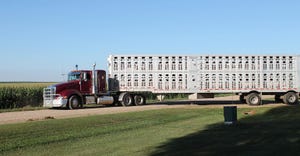
Then the Hormel strike hit and the buying station just 5 miles away couldn't take his hogs. “It was then that I realized I was really vulnerable to the market's comings and goings. I decided I'd better get to where I could fill a semi trailer with pigs. That meant I needed 500 sows to sell 200 pigs/week. That propelled our first growth spurt,” he says.

By 1996, Baarsch says they were growing faster than they could capitalize, so he brought a college friend, Dan Tomsche, DVM, in as a partner.

Tapping Technology

Frustrated with technology application and uptake in the livestock industry, Baarsch launched a search and development initiative of his own. In 2002, he created Herdstar, a spin-off company whose mission statement reads: “HerdStar is dedicated to producing transparent tracing, tracking, and monitoring solutions to the livestock food industry that ensures integrity and safety to the end customer while producing operational savings and management efficiencies to the producer, processor and retailer.”

The company's first products focused on the electronics needed to run the auto-sort scales being introduced to the industry at the time.

Baarsch also saw a need for database capabilities to track grow-finish performance. Gregg Sample, his information officer, was spending many hours converting PigChamp data to spreadsheets. GF Pro, a Microsoft sequel database, was developed to manage this important aspect of Next Generation Pork's production records.

Next on the list, he wanted to get a better handle on marketing data. “I wanted to know what it cost me to sell a pig. Secondly, I wanted to know how much more we could make if we sorted them tighter or finished them heavier,” Baarsch explains. The automatic sorting technology showed promise.

“Hormel kept telling us we could make more money if we sorted better. Well-sorted groups brought 2-3% more than the poorly sorted groups,” he continues.

“I know a lot of producers have an adversarial relationship with their packer. Our philosophy is, if the company asks us to sort hogs closer and is willing to pay for it, I try to give them what they want. They are the customer.”

But Baarsch is quick to add, “That doesn't mean we roll over and say ‘yes’ to everything, but the day they have a problem, we sit down to figure out how to solve it. It has helped our growth. We have a customer who wants us to grow, encourages us to grow, and supports us. It's been instrumental in taking us to the next level.”

Baarsch's retrospective analysis shows they are making about $2 more/pig with the auto-sort scales. “Naturally, there are expenses against that, but that's $5-6/finishing space.”

Future Challenges

Talk of abandoning sow gestation stalls sends Baarsch's blood pressure up a count or two.

“We had a lot of pen gestation in our first sow units. I watched those (newly weaned) sows go at it, head-to-flank, with their full udders. When you opened a gate, the submissive sows would run over you to get out of the pen.

“This isn't about welfare, it's about fear-mongering,” he insists. “Everybody thinks we put sows in stalls for purely economic reasons. That's nonsense. Yes, there are economic reasons, but stalls are also better for the sows.

Still, he concedes, “We can either raise the pork the customer wants or we can find another occupation. We are hoping we have 4-5 years to study the problem so we can implement some ideas on a small scale before we change everything.”

Baarsch also expects the corn price-ethanol challenge to work itself out. “People will come to their senses and realize food's more important than ethanol.”

In the longer term, 5-10 years, he sees “boutique pork” as a real opportunity for the industry. “It amazes me every time I walk into a supermarket to buy deodorant or a tube of toothpaste. You've got 30 different choices. People want that in the pork they buy, too.”

Surprises and Satisfactions

When asked what has surprised him most about his 23-plus years of serious pork production, he grins and says: “Our success! We got into this industry just wanting a lifestyle, and it's ended up being quite a successful business.

“It's also been a pleasure getting to know my colleagues in the industry, whom for the most part, are outstanding people.”

He struggles to single out a mentor. “Really, my mentors have been my wife, my friends and the employees who surround me,” he says earnestly.

His father gets credit for some of the best advice he's received. “‘Keep the pens full.’ There probably isn't a better piece of advice in the hog industry,” Baarsch agrees.

And from his mother, “You have to have faith in tomorrow. Without that faith, nothing happens.”

His nugget of advice to young people interested in the pork industry is this: “This industry is pretty much about relationships. If you can't network or make and maintain relationships, you'd better not get involved. This is too big of an industry, with too much complexity, to be a lone cowboy. If you want to be successful, get in there and mix it up with people — and learn. Everyone wants to say this is a mature industry, and I suppose in some respects it is. But there are a lot of parts that are still evolving and dynamic — and that's exciting.”
Dale Miller, Editor

Continue to next Master: Roy Schultz, DVM >


Jump to:
Bob Dykhuis | Jill Appell | Bob Baarsch | Roy Schultz, DVM | Chris Hurt | Don Levis | Temple Grandin | Alan Sutton | Gary Cromwell | Allen E. Christian

Want to use this article? Click here for options!
© 2009 Penton Media Inc.


Most Recent Story


Most Recent Articles


National Hog Farmer TV

Resources

  • Industry Resources
  • Calendar
  • Blueprint Issues
  • Career Opportunities
  • Pork Checkoff
  • Quarterly/Weekly Hog and Pig Reports
  • Product Info
  • People
  • Production Posters
  • Green Agriculture
  • State of the Pork Industry Report
  • New Product Tour

Current Issue

New Rules for Risk Management

Risk management, it seems, has always been viewed favorably by pork producers. Problem is, it's rarely practiced to any great degree. ...

Current Issue

"Swine Flu" - It's Time to Move On

Something bad has happened to you. It wasn't deserved and it wasn't fair. The people who did it are callous and heartless (at least in regard to you), and lazy, or they would not have done it. But they did it. It's over. It's done. You can whine and wallow in self-pity and martyrdom or pick yourself up, dust yourself off and get on with life and the business of raising quality pork. ...

Marketplace Ads

  • VAL-CO

    Swine Heat Stress. Start thinking about your summer cooling options.

  • Advertise in our Marketplace

    Advertise your business here! Find out how.

  • U.S. Crop and Livestock Maps for sale

    Ag Maps for Sale: U.S. Crop and Livestock Maps

Back Issues Archive