The Masters
Alan Sutton, professor of animal science at Purdue University since late 1971, has been steadfast in his occupational goals since he joined the faculty of the West Lafayette, IN, school 35 years ago.
The modest scientist has stayed service-oriented, helping pork producers with swine nutrition and nutrient management issues, and students with getting an education, and providing students with some valuable lessons about life and faith.
Born in Farmington, IL, on a small, diversified livestock and grain farm, Sutton always enjoyed agriculture and animals, and because of his college experience became enthused about research and education for producers and students.
He earned bachelor and master's degrees in animal sciences and animal nutrition, respectively, at Iowa State University. He completed his educational training with a doctoral degree in animal nutrition from Cornell University.
Despite his emphasis on ruminant nutrition, Sutton ended up taking a position at Purdue University that called for a 70% focus on swine in research and Extension work. His other duties are 10% focus each on poultry, dairy and beef.
Speaking candidly, he recalls: “There weren't many faculty positions or even industry positions open in mid-1971, and this new position came up at Purdue in the area of animal waste management.”
The job interested him because it primarily involved working to meet the requirements of a new law. Indiana was one of the first states to have a confined feeding operation rule.
His position initially was 80% research and 20% Extension. His main research objective was to help producers effectively use animal manure as a nutrient resource while limiting the threat of pollution. That straightforward goal has provided many challenges during his long career at Purdue.
“One thing I did stress, even with those early studies, was to try to look at the impact of diet formulation on manure composition and its impact on crop production,” Sutton stresses. Some early work included studying the impact of growth promotant levels of copper on the pig and the environment, as well as researching the influences of feeding different levels of salt and on sodium buildup in the soil.
“Purdue was one of the first schools to have a nutrient management program,” he says, and its program emphasis has survived the ensuing decades. He offers this timeline:
-
As it started out in the '70s, when animals were being brought into confinement, the emphasis was on manure management and getting value out of the manure.
-
During the '80s, research funding in this area virtually dried up, and Sutton turned his attention to the impact of microorganisms in the digestive tract of the pig, looking at the effect of feed additives and probiotics on the diet. It was a time when there was a lot of attention placed on researching substitutes for antibiotics in swine diets, he says.
-
In the '90s, the focus turned back to a heavy research effort focused on diet manipulation to reduce nutrient excretion as the Environmental Protection Agency ramped up regulation of farms. The difference from the '70s, says Sutton, is the new emphasis on the impact of odor and gas emissions from hog barns, along with concerns about water quality. The focus continues in the current decade.
One of Sutton's remaining major projects is a joint research effort with Rick Koelsch of the University of Nebraska. The project, funded by Pork Checkoff, involves studying parameters needed to achieve whole-farm nutrient balance.
Participating are 4-5 farms each from Nebraska, Iowa and Indiana that have been willing to share their records to evaluate the amount of nutrients that are brought onto, and taken off, the farm, he explains.
The data accumulated will be used to develop programs to avoid an over-abundance of nutrients on hog farms, which could potentially impact water quality or air quality.
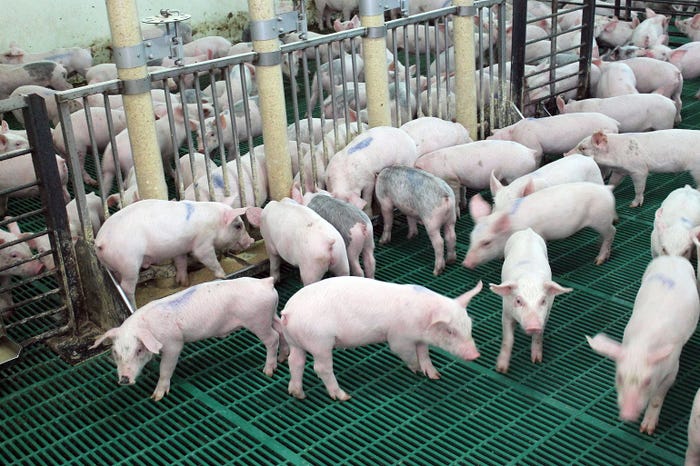
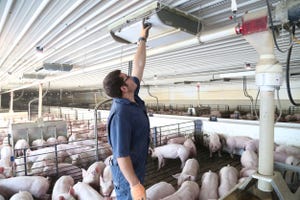
Of particular help in the area of air quality in other projects funded by USDA is Purdue's two-year-old Swine Environmental Research Building. The wean-to-finish facility features 12 identical, self-contained rooms with separate ventilation and 6-ft-deep manure pits. Actually, each room has two distinct manure pits, which have tested whether air emissions are improved by flushing out the manure monthly, or by retaining the manure in storage and pumping it out to an above-ground Slurrystore system at the end of the production cycle. The two manure pits are also valuable for split-sex feeding of barrows and gilts to assess manure composition. Rooms hold 60 pigs each.
Additional air quality research headed by Purdue animal scientist Scott Radcliffe and Brian Richter, comparing low-nutrient excretion diets with control diets, is expected to show significant reductions in nitrogen excretion and ammonia and hydrogen sulfide gases.
Sutton defends swine industry research in this area against critics, emphasizing that the goal is to produce science-based research that will hopefully provide pork producers with the tools they need to improve pork production and protect the environment.
Sutton's goals includes investigating byproduct feeds, such as dried distiller's grains with solubles, glycerol and other feed alternatives, and their impact on nutrient utilization, nutrient excretion and gaseous emissions.
During this time, his Extension work will center on helping to develop a feed management curriculum, Web-based learning center and fact sheets and tools to train and inform educators, producers, legislators and the public in the use of feed management practices for efficient pork production, protecting the environment and to assist policymaking of federal, state and county animal feeding operation regulations.
Sutton currently serves as a member of the National Pork Board Environment Committee and is domain editor of environmental stewardship for the Pork Information Gateway.
Reflecting his service-oriented and team focus, Sutton has been named Department of Animal Sciences counselor from 1992 to 1997 and again in 2005-2006. He served on the Purdue College of Agriculture Team in 2005. He received the Indiana Pork Producers Industry Meritorious Service Award in 2003. He served as Midwest Section director of the American Society of Animal Science from 1998 to 2002.
His mentors are virtually too many to mention, he says, but he cites former Purdue animal scientists Vern Mayrose, Jim Foster and long-time agricultural engineer Don Jones.
Sutton has given much thought to the future of the swine industry. He foresees much more sophisticated, specialized operations that will pursue precision feeding of pigs based on genetics and nutrient availability, innovative diet formulations that may include new, genetically derived sources of feeds or partial replacement of corn as the main staple of the diet, providing new energy sources that improve efficiency and that remain in balance with the environment.
His best advice to be successful: “Do your best and be thorough. Encourage others and be a team player, and be willing to say you don't know, but you will try to find the answer.”
— Joe Vansickle, Senior Editor
Continue to next Master: Gary Cromwell >
Jump to:
Bob Dykhuis | Jill Appell | Bob Baarsch | Roy Schultz, DVM | Chris Hurt | Don Levis | Temple Grandin | Alan Sutton | Gary Cromwell | Allen E. Christian
Want to use this article? Click here for options!
© 2009 Penton Media Inc.