The Growing Role of Swine Influenza Virus
Although porcine reproductive and respiratory syndrome (PRRS) was recognized in the U.S. swine population as early as 1989, the porcine respiratory disease complex (PRDC) was not recognized until the middle of the following decade.
Among the pathogens associated with PRDC, Mycoplasmal pneumonia and swine influenza virus (SIV) were most commonly seen when finishing pigs hit the “respiratory disease wall” at ages 14 to 17 weeks. Clinical disease is more severe in pigs that are infected with both agents.
In 1997, a wasting disease associated with porcine circovirus type 2 (PCV-2) infection was described. Within the last two years, several investigators have confirmed PCV-2 as the main cause of postweaning multisystemic wasting syndrome (PMWS). Due to its ability to suppress the immune system of the pig, it can also be a major contributor to PRDC.
SIV History
Until PRDC was recognized, pigs were not routinely vaccinated for SIV. It was realized that control of SIV in the growing pig could minimize the impact of PRDC, and pig vaccination became common. Using an existing commercial vaccine and proper timing, control was easily accomplished through vaccination of sow herds and growing pigs.
More recently, producers were confronted with another disease that looked like SIV, but did not respond to vaccination against H
For the next year, H
Viral Reassortment
Along with the return of H
When pigs are simultaneously infected with both H
In the United Kingdom (UK), H
Because it is derived from two viruses for which vaccines are already available, disease may be minimal for herds vaccinated against both H
Subtype Identification
Due to the presence of three different subtypes of SIV in U.S. herds, it is very important to determine which subtype is causing disease in your herd. Serologic testing alone for H
Only specific typing of the viral isolate will confirm infection due to H
Diagnosing SIV
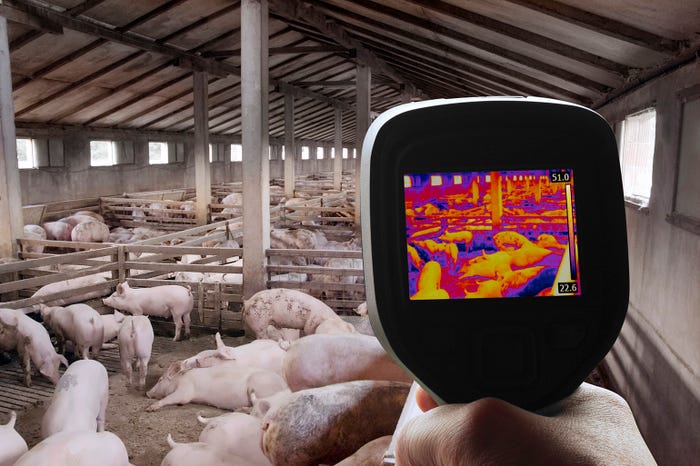
To make subtyping possible, submit the proper samples for diagnostic evaluation. In all cases, pigs or pig specimens should only be submitted for virologic evaluation when pigs or sows are febrile (body temperatures of 104° F or higher with a clear nasal discharge). Pigs or sows with white nasal discharge should not be submitted.
Viral shedding is very brief for SIV and typically doesn't exceed five days from the time of exposure (the first 2-3 days of clinical illness). Affected nursery pigs will be reluctant to rise or will move very slowly and will be hot to the touch.
If abortions occur as a result of SIV, sows will be off feed and feverish.
For lab submissions to confirm the presence of SIV, swab sows near aborted sows that appear normal but have a fever of 104° F or higher. Deep nasal swab specimens should be collected with dacron or polyester swabs, being certain to insert the swab towards the center of the nose to assure sampling of the nasal septum epithelial lining. Discard swabs with a lot of blood.
Swab samples should be kept moist and cool after collection for submission to the laboratory. Place swabs in a closed tube with a few drops of non-chlorinated water or saline.
When growing pigs are examined for lesions, SIV-infected lungs typically have a blotchy red lesion pattern due to a bronchopneumonia. The lesion areas and a small amount of adjacent, normal-appearing lung tissue should be submitted for laboratory examination.
Fresh lung can be examined by the fluorescent antibody tissue section test or by direct antigen capture enzyme-linked immunosorbent assay (ELISA). Both procedures are rapid and can provide confirmation of SIV within a matter of minutes to a few hours.
Serologic Evaluation of Herd Status
Serologic testing with either the hemagglutination inhibition (HI) test or by ELISA is needed to determine if vaccination is properly timed to prevent clinical disease in both sows and pigs. Even when the proper subtypes are included in a vaccination program, results may not always be satisfactory. Two of the most common causes of failure to control clinical disease by vaccination are improper gilt immunization and vaccination of growing pigs when residual colostral immunity is present.
Pigs with HI antibody titers as low as 1:10 may not respond to vaccination against H
A common question concerns the relationship of an ELISA S/P (sample to positive) value to HI titers in terms of ability to vaccinate pigs. At this time, a commercial antibody test kit is only available for H
When using ELISA serology to evaluate sow herd vaccination programs, it is very important to evaluate gilts and low parity sows to determine if their serologic profiles match those of the older sows in the herd.
Gilts and sows should be bled 2-3 weeks after their 30-day pre-farrow booster immunization. By testing at that time, antibody levels are highly reproducible and represent the peak immune response to the booster vaccination. No less than 10 gilts, 10 parity 1 sows and 10 parity 2 sows should be bled and compared to 30 serum samples evenly distributed across all older parity sows. From 10 to 20, 3- to 4-week-old nursery pigs should be bled for herd evaluations.
ELISA data should be evaluated by determining the geometric mean S/P ratio for each parity tested. A geometric mean is different from a arithmetic mean (adding all S/P values and dividing by the number of pigs tested). Geometric mean values involve the addition of logarithmic values, divided by the number of samples. Geometric mean S/P compensates for changes in antibody development in the pig during its immune response to infection.
Evaluation of the geometric mean S/P for each parity will determine if gilts are being properly immunized before entry into the sow herd. Herds with little disease due to H
Older parity sows (P-6 or higher) are most likely to have S/P values of 1.60 or greater. Geometric mean S/P values for gilts, P-1 and P-2 sows should be very similar, and should be nearly the same as those obtained for older parity sows.
Routine use of the H
Maternal antibody S/P values in 3-week-old pigs will mirror the overall sow herd geometric mean S/P. For example, a sow herd mean S/P of 1.50 will typically result in a 3-week-old nursery pig S/P value of around 1.4. It appears that the colostral antibody “half life” or uniform decay pattern by ELISA is a linear decay curve of 2-week increments.
Vaccination Protocols
USDA-licensed vaccines have been proven to be effective against both H
In some cases, replacement gilts are vaccinated once as grow-finish pigs. It is important to realize that a single dose of SIV vaccine will only prime the pigs for a secondary immune response to either a second dose of vaccine or natural infection with SIV. For that reason, a gilt that receives a single dose as a growing pig should also receive two doses of SIV vaccine either later on in the gilt developer prior to shipment or in isolation prior to addition to the sow herd.
When clinical losses are occurring due to SIV in the middle of the finishing period, some producers and practitioners choose to adopt a finishing pig vaccination program against SIV. Remember that inclusion of the subtype of SIV causing disease, in the vaccine administered, is critical to long-term control of SIV on the farm.
The sow herd vaccination program must be coordinated with grow-finish vaccination. Sow herds using a 30-day pre-farrow booster immunization program will provide pigs long-lasting immunity through the nursery. This means that finishers will have to be vaccinated at a heavier weight. Most commonly, immunization with SIV vaccine will not be possible until 12-16 weeks of age.
If SIV hasn't been a problem in sows or nursery pigs for some time, sow revaccination can be changed to a weaned-sow booster program. Such a change results in lower maternal antibody transfer to pigs, thereby providing an opportunity for younger grow-finish pig vaccination.
Prevention and Impact of Antigenic Drift
Antigenic drift has been mentioned many times over the past two years as a possible reason why vaccines sometimes fail to protect sow herds and pigs against SIV. This is caused by amino acid changes in the surface proteins of SIV. If the change is due to infection of partially immune pigs, then the virus can gain an edge to infect those pigs. This would require a change to a newer strain of SIV in the vaccine.
There still is no scientific basis for such a claim of antigenic drift regarding H
The situation is not nearly as clear for H
Whether these variances represent major antigenic drift among H
To date, there is no indication that H
Want to use this article? Click here for options!
© 2008 Penton Media Inc.