Setting Pigs Up to Succeed
Investing in the first day of a pig's life can make a pivotal difference in its lifetime performance.
Previous Page: Goal One: Preventing Fallouts
Another warming strategy commonly recommended by CVS is to place an 18-gal. plastic tub underneath the heat lamp, which is referred to as a “survivability box.” Place up to an inch of feed in the bottom so the surface is not slippery. “Pop a pig in the box and in no more than five minutes, the pig is nice and dry, pink and ready to nurse the sow,” Miller says. Usually 1-3 pigs are placed in the box at a time.
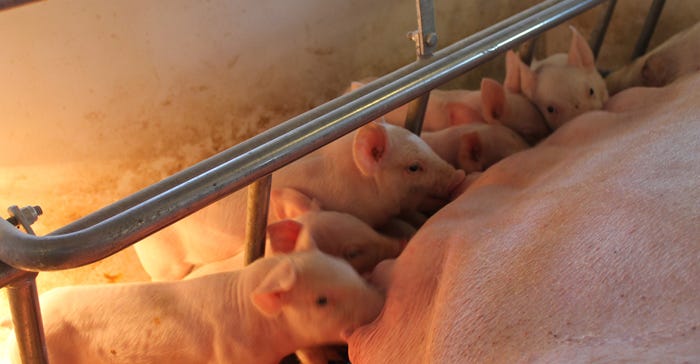
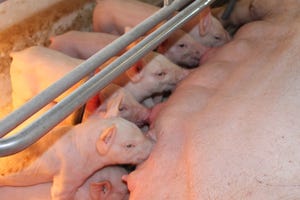
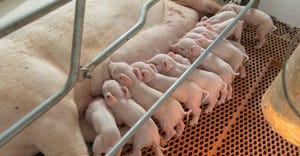
A common scenario for just-farrowed litters would be a sow with 10 pigs but 13 functional teats that could accommodate three more pigs. Miller reminds that prior to moving any pigs to other sows, the piglets must absorb their first colostrum. “To set pigs up to accept the challenge of movement, we need to get colostrum in their belly,” she says.
Reducing variation in litters by ensuring consumption of colostrum can be highly successful through use of a management technique called split suckling. This technique can reduce the number of pigs under 8 lb. at weaning by 50%, according to research done by Tara Donovan, DVM, in 2001.
To fulfill split suckling, after a litter of pigs is farrowed, take the first born or biggest 4-5 piglets off the front teats and place them in the survival box, leaving the smaller half of the litter to nurse without competition. Leave these smaller pigs on the sow for about 30-60 minutes or until their bellies appear full of colostrum, Miller instructs.
“Often when they are full, the pigs go to sleep, just like we do after Thanksgiving dinner. This is a good sign they've had enough. Do not leave pigs in the box away from the sow for more than 1½-2 hours. This is too long without a meal for these young pigs,” she warns.
Miller says research shows the biggest pigs consume adequate colostrum within eight hours, whereas it can take up to 24 hours of nursing before the smallest pigs have achieved proper levels.
Adequate consumption of colostrum is critical to pig survival. Because colostrum is packed with valuable antibody proteins, it is important that all pigs in a litter have time to consume and absorb enough colostrum.
It's important that the proper person be designated “midwife” to follow farrowing sows and ensure all pigs have enough colostrum prior to doing some subtle movement to put the right number of pigs on sows according to functional teats.
“I believe in doing some early fostering, but I don't call it crossfostering, because I think that term is associated with continuous fostering, and we want this process to be smart, small and really focused on getting pigs to functional teats with minimal movement,” Miller emphasizes.
In contrast, continuous crossfostering (by creating one-for-one pig switches throughout lactation) is an example of too much intervention that reduces variation, reduces the total amount of pork out the door and creates a uniform group of smaller pigs.
Goal Three: Runt Pig Litters
There is one group of pigs that should be selected to make a runt pig litter — the very smallest pigs in the room. Pull those pigs off sows and place them on a Parity 2 or 3 sow that has smaller teats that are aligned better to raise those pigs, Miller says.
Gilts shouldn't be used to nurse runt pigs because these runts don't nurse hard enough, and gilts have a higher risk of shutting down milk production on their first litter, she warns. It's better to select a second- or third-parity sow with small teats to serve as a nurse sow.
“One thing we do with runt litters is put more pigs on that sow than we would normally. By putting 15-16 pigs on that sow, we can truly maximize her functional teats. We do expect more of these pigs to die due to weakness or underdevelopment. But one thing that helps is to provide supplemental milk to help these pigs out the first two days. Often if runt pigs have a chance to drink some milk in a pan, they then have enough energy to latch on and nurse better.
“I've seen some caregivers who are just phenomenal at raising these small pigs, and when done correctly, you have a hard time telling those pigs from the rest of the weaned group,” Miller attests.
But keep a close eye on sows raising these runt litters because they are more likely to get mastitis if they don't get nursed out every day. Also, be sure to check all sows in the farrowing room for early signs of this milking malady. If sows' eyes look glassy, or they are lying on their belly in the stall and their teats are hot, it's time to treat the infection and the pain the sow is experiencing,” Miller says.
Pig Processing
“Research disagrees on the best time to process pigs, but I typically recommend that Day 0 or Day 1 be a time that pigs are left undisturbed.
“When we do process, there are things that occur that have the potential to create disease, which can increase variation if we are not careful,” Miller cautions. Disinfect tools between litter treatments. Change needles frequently.
Giving iron shots is one of the most important newborn pig treatments. Studies show piglets need at least 200 mg. of iron in the first three days of life. “You skip giving a pig iron and you have created a pig that is going to be smaller throughout the rest of its life,” she declares.
To prevent iron leakback, which could cause the pig to be iron deficient, try this technique: stretch the pig's neck a little, give the iron shot in the neck and release the neck as you pull the needle out. “When you release the skin, the hole in the skin and the hole in the muscle from the iron shot don't quite line up, creating a cap over the hole where the iron went in, thus holding the iron in,” Miller says.
Use a sharp blade for castration. To repair scrotal ruptures, consider a nonsurgical taping method that has a very high rate of success. The method was featured in National Hog Farmer (“Less Invasive Rupture Repair,” Jan. 15, 2006, pages 20, 21).
Whether it is spotting a pig with iron leakback or a pale pig, intervention must be timely. “We need to look at every litter, every day, and if there is a pig that needs to be treated, treat it and treat it appropriately,” she says.
Farm Fallout Problems
One of the biggest problems is that farm staff wait to pull fallouts until 10-12 days of age, not giving them much opportunity to recover.
At 3-7 days of age, find and pull these pigs and place them on a nurse sow, and they should have a good chance of recovery. Miller says a good technique is to move a good-milking, weaned sow back to an empty farrowing crate to become a nurse sow.
She adds: “We know that our gilts do better on their subsequent litter if they are nursed longer, so this is one area where we may actually use gilts as nurse sows.
“We like bumping the sows down (back into farrowing) better than bumping litters up (weaning pigs early), because bumping litters out can create variation in your finisher barn because those pigs didn't get to nurse as long as other litters,” Miller notes. Every day pigs are weaned later than Day 14 up to Day 22 is worth 89 cents to $1.50/pig in additional profit, she adds.
Next Page: Pig Processing
Want to use this article? Click here for options!
© 2009 Penton Media Inc.