NHF Digital Edition

Get our FREE digital edition! Subscribe here.

Take Another Look At Later Weaning

Increasing weaning age while reducing breeding herd inventory may help cut losses.

Challenging the conventional wisdom about maintaining breeding herd inventories may be a strategy to reduce losses, given the current economic conditions in the pork industry.

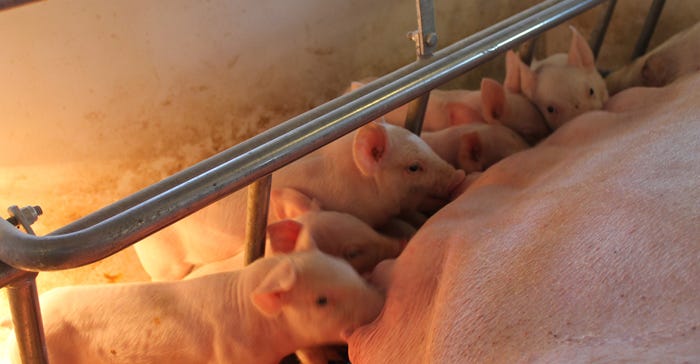
In 2004, Kansas State University (KSU) research by Rodger Main and others challenged the merit of very young weaning ages common in the industry. The KSU work showed significantly reduced preweaning mortality for pigs weaned at 21 days of age, relative to those weaned at 12, 15 and 18 days of age, and wean-to-finish feed conversion was also improved.

Many producers increased weaning ages by adding more space in farrowing to accommodate the longer lactation periods without reducing breeding herd inventories. Current economic conditions preclude adding more farrowing space to accommodate older weaning averages. However, in an effort to minimize losses, it may be time to consider increasing weaning age while reducing breeding herd inventories.

In the 1980s and 1990s, the pork industry transitioned from outdoor production with relatively low fixed costs to total confinement and relatively high fixed costs. To make money in a high fixed cost industry, throughput is the key. For pork producers, that means spreading costs over more pigs and pounds of pork.

Maximizing throughput of the breeding herd is accomplished by:

  1. Maintaining breeding herd inventories to fully utilize the space available in breeding/gestation, nursery and finishing facilities;

  2. Decreasing weaning age to increase turnover of farrowing space; and

  3. Increasing the productivity of breeding females by increasing the number of pigs weaned/breeding female/year.

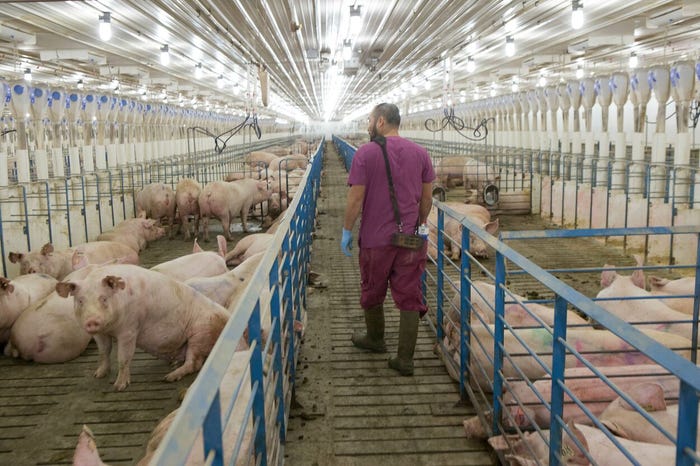
Farrowing typically is the most expensive space to build. It is also the bottleneck that limits the number of pigs produced in most production systems.

Weaning age works like a flow regulator on the farrowing crates by increasing or decreasing the number of litters that can be farrowed and weaned from each crate. Increasing the weaning age slows the flow; decreasing the weaning age increases the flow. Increasing the flow requires more females in the breeding herd and means more growing pigs.

But is weaning at a younger age to produce more pigs always better? Younger pigs are harder to manage in the nursery, require more of the most expensive starter diets and may not perform as well from wean to finish. Furthermore, younger weaning ages mean shorter lactation lengths for breeding females, which give them less time to recover and may decrease reproductive performance in subsequent litters.

The advantages of weaning older pigs may include:

  • Spreadsheet Software

    Less expensive starter diets;

  • Decreased wean-to-finish mortality;

  • Increased wean-to-finish average daily gain;

  • Improved wean-to-finish feed conversion ratio;

  • Increased percentage of full value pigs marketed;

  • Lower animal health costs;

  • Increased farrowing rate in subsequent parity;

  • Increased pigs born alive in subsequent parity; and

  • Decreased prewean mortality in subsequent parity.

Whether it pays to increase weaning age by reducing breeding herd inventory depends upon whether the advantages to weaning older pigs compensate for the loss of throughput.

The payback potential is very sensitive to market hog prices relative to diet costs. When market hog prices are high relative to diet costs and margins on every pig, the reward for producing more pigs is high. Anything that reduces the number of pigs produced, including reducing the breeding herd inventory, is going to reduce the profitability of the operation. The advantages to weaning an older pig won't likely be enough to compensate for the loss of throughput.

The opposite is true when market hog prices are low relative to diet costs and when margins are low. Given the low margins the industry has experienced for the past two years, reducing the breeding herd inventory to increase the weaning age may be a strategy to reduce losses in today's economic environment.

A breed-to-finish production and budgeting spreadsheet designed specifically to evaluate whether it pays to reduce breeding herd inventory to increase weaning age is available from the Iowa Pork Industry Center (IPIC) at Iowa State University (ISU).

The spreadsheet is free, but requires completion of an online registration form. Go to the IPIC free software page, http://www.ipic.iastate.edu/software.html, choose “Spreadsheets,” and then “Economics of Weaning Age Calculator.” The spreadsheet works with Microsoft Excel 2003 and newer versions.

Next Page: A Case Study

Want to use this article? Click here for options!
© 2010 Penton Media Inc.


Most Recent Story

Most Recent Articles


National Hog Farmer TV

Interact With Us

National Hog Farmer on Facebook National Hog Farmer on Twitter

Resources

  • Industry Resources
  • Calendar
  • Blueprint Issues
  • Career Opportunities
  • Pork Checkoff
  • Quarterly/Weekly Hog and Pig Reports
  • Product Info
  • People
  • Production Posters
  • Green Agriculture
  • State of the Pork Industry Report
  • New Product Tour

Current Issue

Congrats Dale! Then Down to Business

Before I get to this week’s topic, I must take a moment to congratulate National Hog Farmer and Weekly Preview Editor Dale Miller for his receiving the Pork Checkoff's 2010 Distinguished Service Award. The award is given annually to recognize the lifelong contribution of an outstanding leader to the pork industry.

Last Week's Issue

Counter-Seasonal Decline is Good News for Pork

USDA's Cold Storage report, released last week, continues to indicate that supplies are at least "current" at present. The cold storage data appear in Table 1.

Marketplace Ads

  • VAL-CO

    Swine Heat Stress. Start thinking about your summer cooling options.

  • Advertise in our Marketplace

    Advertise your business here! Find out how.

  • U.S. Crop and Livestock Maps for sale

    Ag Maps for Sale: U.S. Crop and Livestock Maps

Back Issues Archive