Tall Corn, Deep Roots
“One of the lessons passed down from Grandma and Grandpa, as well as through my parents, was, ‘You don't have to be wealthy to keep things neat and clean,’” he says.
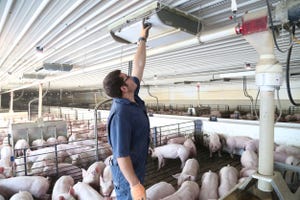
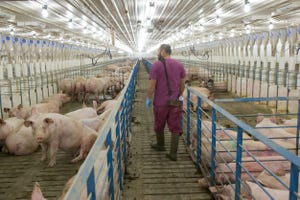
The elder generations also taught Roger that a little hard work never hurt anybody. Put those lessons together and you can see how JAC Pork — named for Roger's children, Jeremy, Andrew and Christine — has built its reputation as a hog operation with a manicured landscape outside the facility and immaculate housekeeping inside the barns.
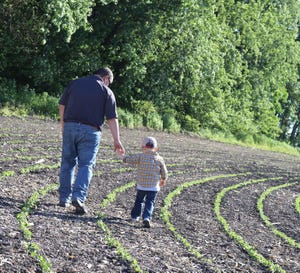
The Nath children represent the fourth generation to have grown up on this northwest Iowa farm. The grandkids that come to visit mark the fifth generation. “As I enter into my sixth decade of life on this five-generation farm,” Roger says, “I have deep roots that hold me accountable to the land and to the environment, which has sustained all five generations.”
Hogs and corn
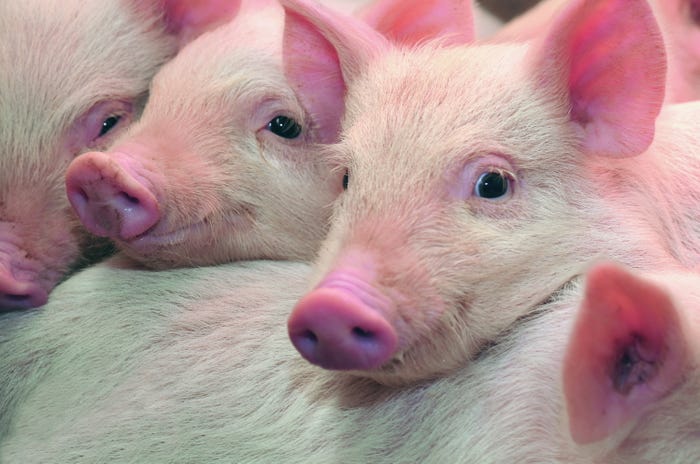
JAC Pork, which consists of two fully slotted finishing buildings housing 1,760 hogs each, is the heart of this highly productive farm. Roger and his wife, Renee, also farm 700 acres in a corn/soybean rotation. Manure nutrients feed the corn crop, pushing yields past 200 bu./acre.
“We're basically in a cycle. We raise corn to feed hogs and the hogs produce nutrients that we use to raise corn,” Roger explains.
That's a simple way of describing the farm's manure management program, which focuses on gaining an economic advantage by using manure nutrients to grow crops in a corn/soybean rotation. JAC Pork applies nutrients according to a nutrient management plan approved by the Iowa Department of Natural Resources.
A stainless steel scraper system installed in a shallow pit pushes manure to the center of the 42 × 380-ft. buildings. The manure flows through an 8-in., underground PVC pipe to a lift station that pumps the effluent to a 250 × 250-ft. earthen storage basin.
“We built the earthen basin to provide additional capacity and give us some flexibility in the timing of our application,” Nath says. “The site produces about 1.2 million gallons of effluent a year, but we can store up to 3 million gallons. Ideally, we inject the manure in the fall onto soybean stubble for fields that will be planted to corn the next spring. But if the weather doesn't cooperate, we can delay application until conditions are right.”
Manure application is a big job that takes place on a compressed timetable. Three agitators run for four hours in the earthen basin, blending the material for uniformity. Manure is pumped out through a drag-line hose system where it is injected to a depth of about 10 in. using a chisel plow. All fields are located within a mile of the facility, so hoses never leave the section where the buildings are located.
Running around the clock, Nath can complete the entire application in 30 hours or less.
Manure samples are collected during the application period so he can calculate the nutrient rates as well as the financial impact of the manure nutrients. The effluent typically runs an approximate analysis of 20-25-30 (nitrogen-phosphorus-potassium) per thousand gallons, and the manure plan calls for up to 10,000 gal./acre for fields with proven high yields.
After subtracting pumping costs, Nath figures the annual application saves nearly $45,000 as compared to purchasing the equivalent amount of commercial fertilizer, based on fall 2008 prices.
There may be additional benefits from manure nutrients that he's not including in those figures. “We know there are additional micronutrients that come with the manure application, and those help plants stay healthy and green when under stress,” he says. After 12 years of using manure nutrients, he says corn yields are running 20 bu./acre higher than fields receiving commercial fertilizer only.
Creating compost
The barns were originally constructed as contract finishers in 1997, but Nath renovated them in 2003 to serve as gilt developing units. Currently, the barns are back operating as finishers under contract with Murphy-Brown.
In 2003, Nath also decided to build a six-bay compost unit to handle mortalities. “With our contract for the gilt developer unit, I wanted to maintain the highest level of biosecurity possible,” he recalls. “That meant keeping rendering trucks away from the farm. I studied a number of composter designs and came up with a plan that we built ourselves.”
It features poured concrete pads and sidewalls, with an adhesive bentonite strip between each floor and wall joint to provide additional sealing. The floor also slopes toward the back wall to keep seepage in place. A 20 × 70-ft. concrete pad makes for tidy access to the compost bays when using a front-end loader to turn the compost material. A built-in sprinkler system provides an easy way to maintain the ideal 65% moisture level in the compost.
Each bay is 10 × 20 ft. and can handle up to 4,500 lb. of mortalities. Wood chips are used as the carbon source. Piles are turned and moved regularly until they are applied to land as crop nutrients.
“This is a great way to handle and recycle mortalities,” Nath says. “We're saving $1,000 a year on rendering costs, in addition to having improved biosecurity. And everyone who visits is impressed by the lack of flies and absence of odor.”
Next Page: Innovations abound
Want to use this article? Click here for options!
© 2010 Penton Media Inc.