Subscribe to Our Newsletters
National Hog Farmer is the source for hog production, management and market news
December 9, 2011
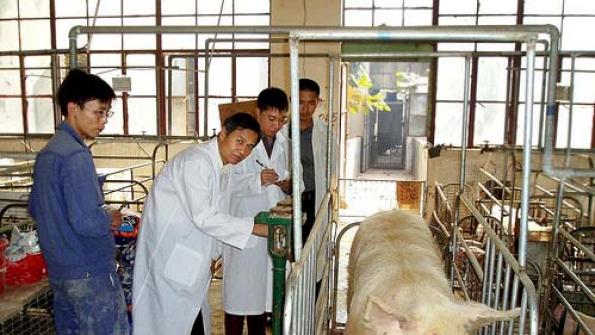
The U.S. soy industry, represented by the American Soybean Association, the U.S. Soybean Export Council and the United Soybean Board, recently used USDA Market Access Program and Foreign Market Development Program funding to provide valuable technical training to the Chinese swine sector, according to a U.S. Department of Agriculture blog by Katie Gorscak of the Foreign Agricultural Service.
The gradual shift of Chinese swine production from traditional backyard farming toward more commercial-scale production has increased consumption of commercial feed, particularly soybean meal. Gorscak wrote.
China remains the world’s largest market for U.S. soybeans, importing a record 24 million tons, valued at $12.1 billion, in fiscal year 2011. U.S. soybean exports to China have increased in each of the past five years and this growth can be linked to expansion in the crushing sector, where imported soybeans are processed into oil for food and meal for animal feed.
According to the Chinese Ministry of Agriculture, there has been significant growth in the number of hog farms with annual output of 500 head or more. This trend is expected to continue, presenting even more growth opportunities for U.S. soybeans in that market. Pork accounts for nearly three-fourths of Chinese meat production, Gorscak wrote.
To capitalize on these opportunities, the U.S. soy industry provided technical assistance throughout 2011 to representatives from Chinese swine farms, feedmills, animal health companies and crushing plants. The U.S. soy industry conducted more than 40 seminars and 30 one-on-one farm consultations, as well as sponsoring feeding trials using soy products and bringing a Chinese study team to the United States.
Through these efforts, members of China’s swine industry learned about modern hog raising techniques, advanced nutrition concepts, genetics and breeding improvement and disease prevention and control. In the process, they also gained an understanding of how using U.S. soy in their swine feed can maximize not only animal performance but also their operations’ bottom line.
Currently, the American brand of agriculture is surging in popularity worldwide, according to Gorscak. Farm exports in fiscal year 2011 reached a record high of $137.4 billion—exceeding past highs by $22.5 billion—and supported 1.15 million jobs here at home. The agricultural trade surplus stands at a record $42.7 billion. For the first full fiscal year, China was the lead export market for farm products, buying almost $20 billion of goods such as soybeans, cotton, tree nuts and hides. There is no doubt that the Asia Pacific region recognizes the United States as a reliable supplier of the highest-quality food and agricultural products.
You May Also Like
Enter a zip code to see the weather conditions for a different location.