NHF Digital Edition

Get our FREE digital edition! Subscribe here.


      Share

Pigs in Bottom Nose Trailer Compartment Have More Stress, Lower Meat Quality Scores

Pigs hauled in the bottom nose compartment of a pot-belly trailer have much greater risk for higher levels of stress and poorer meat quality, according to a study at the Prairie Swine Centre in Saskatoon, Saskatchewan.

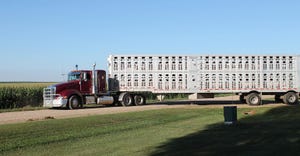
A total of 1,170 market pigs were hauled in summer and winter during six-week periods in a pot-belly trailer for eight hours from Saskatoon to Brandon, Saskatchewan.

Compartments were categorized. Pigs in the middle deck did not have to use an internal ramp. Pigs in the belly compartment had to descend a ramp during loading and ascend during unloading. Pigs in the upper deck ascended a ramp during loading and descended it at the packing plant. Pigs in the bottom nose compartment had to ascend and then descend ramps during both loading and unloading.

Focal pigs located throughout the truck were equipped with heart monitors and then sampled for lactate levels at slaughter and evaluated.

All pigs were fasted 8-9 hours before loading (21 hours before slaughter) and kept in holding pens at the packing plant for 1.5 hours prior to slaughter.

Various muscle pH readings, light reflectance and drip loss were taken to assess pork quality.

Pigs loaded in summer in the bottom nose presented higher heart rate readings at loading compared to those located in the bottom deck, with pigs in the middle deck and upper deck being intermediate. During transport, pigs loaded in the upper deck and middle deck had higher heart rates than pigs in the bottom deck and bottom nose compartments.

At slaughter, blood lactate levels were higher in pigs transported in the bottom nose section. The higher heart rate and lactate levels may reflect the greater physical effort required of pigs to climb the very steep ramp giving access to the bottom nose compartment.

Meat quality was somewhat affected by this physical effort as those pigs in the bottom nose compartment displayed higher pH values and lower drip loss.

In winter trips, pigs loaded in the bottom nose showed a higher heart rate at loading and higher blood lactate levels.

Meat quality was also affected by animal location during winter transport of pigs, with those in the bottom nose compartment showing higher pH values and lower drip loss.

Higher pH values and low drip loss indicate that these pigs are prone to poor meat quality referred to as dark, firm and dry as the result of an extended period of stress.

Researchers: J.A. Correa and J.P. Laforest, Laval University; H.W. Gonyou, Prairie Swine Centre; T.M. Widowski, C. Dewey and R. Bergeron, University of Guelph; S. Torrey and L. Faucitano, Agriculture and Agri-Food Canada; N. Lewis, University of Manitoba; and T. Crowe, University of Saskatchewan. For more information, contact Gonyou by phone (306) 667-7443, fax (306) 955-2510 or e-mail harold.gonyou@usask.ca.


Top Viewed Articles for 2009

1. Free Selection Guides and Management Posters
2. New Product Tour 2009
3. What is Net Present Value?
4. Cash Flow Hedges Have Accounting Implications
5. Dealing with H1N1 Flu Questions

6. The Swine Industry is at a Crossroads
7. Feed Alternatives Not A Quick Nutritional Fix
8. Big Guys Announce Sow Herd Cuts, Others Wait
9. Pork Industry Here to Stay
10. Putting the Hog:Corn Ratio in Context

Want to use this article? Click here for options!
© 2010 Penton Media Inc.


Most Recent Story

Most Recent Articles


National Hog Farmer TV

Interact With Us

National Hog Farmer on Facebook National Hog Farmer on Twitter

Resources

  • New Product Tour
  • Calendar
  • Blueprint Issues
  • Career Opportunities
  • Pork Checkoff
  • Quarterly/Weekly Hog and Pig Reports
  • Product Info
  • People
  • Production Posters
  • Green Agriculture
  • State of the Pork Industry Report
  • Industry Resources

Current Issue

MARKET PREVIEW by Steve Meyer

Cutout Values Keep on Breaking Records

Another week, another record-high cutout value seems like no big deal. That's the way it goes in this wonderful pork industry. Right?...

SWINE HEALTH PREVIEW PREVIEW

Actinobacillus suis Activity Persists

A little over two years ago, we commented on a general rise in the frequency of Actinobacillus suis (A. suis) isolation from our swine tissue submission cases, and wondered if it was related to the increased porcine circovirus type 2 (PCV2) activity (National Hog Farmer North American Preview, June 6, 2008)...

Legislative Preview

Mexico Adds Tariffs to U.S. Pork Over Truck Access Issue

The Mexican government has added pork to the list of U.S. products against which it is retaliating for the failure of the United States to live up to its obligations under the North American Free Trade Agreement (NAFTA) to let Mexican trucks haul goods into the United States...

Marketplace Ads

  • VAL-CO

    Swine Heat Stress. Start thinking about your summer cooling options.

  • Advertise in our Marketplace

    Advertise your business here! Find out how.

  • U.S. Crop and Livestock Maps for sale

    Ag Maps for Sale: U.S. Crop and Livestock Maps

Back Issues Archive