NHF Digital Edition

Get our FREE digital edition! Subscribe here.

Reducing Pig Transport Losses

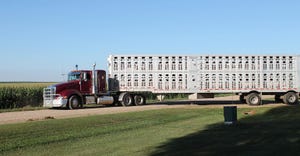
A comprehensive study of over 9,600 trailer loads carrying over two million market hogs helps identify the causes and the costs associated with pig transport injuries, fatigue and deaths.

Previous Page: Associated Factors

Focus on Pig Density

A renewed effort to evaluate the effects of transport floor space on losses — calculated as sq. ft./pig or pigs/sq. ft. — is underway. This variable was expressed as “trailer density” and calculated as total pig market weight divided by the square feet of trailer space available to the pigs. This factor showed the greatest variation in transport losses over the ISU study period.

As trailer density increased in terms of lb./sq. ft., so did transport losses (Figure 1). The association between transport losses and trailer density is supported by a number of other studies.

With greater attention being paid to fuel costs, there is a temptation to increase the number of pigs per load or increase the market weight per pig to reduce transportation costs.

However, underestimating the average body weight/pig by 10 lb. (i.e., from 265 to 275 lb.) for an average of 168 pigs on the trailer in this study resulted in a 0.13% increase in transport losses per load. Similarly, increasing the number of pigs in a small trailer compartment, such as those in the rear of the trailer (59 sq. ft.) by one pig (21 vs. 22 pigs at 265 lb.), increases trailer density in that compartment by 3 lb./sq. ft. Transport losses would likely increase by 0.14% pigs/load in this example.

Clearly, it is important to calculate the available transport space to the pigs in the trailer, subtracting any areas where pigs cannot stand or lie down. Likewise, it is important to obtain accurate weights of the market pigs, which will allow producers to calculate the pounds per square foot in each compartment of the trailer.

The “ideal” transport space per pig is still uncertain and, logically, varies with the ambient temperature. Research suggests, however, that transport losses are minimized between 55 and 58 lb./sq. ft., although some researchers suggest densities as low as 51 lb./sq. ft. to minimize transport losses.

A loading density calculator, developed by, and available from, Elanco Animal Health is a tool to assist producers in calculating the appropriate number of pigs per trailer compartment during loading. (For a copy of the calculator, contact dr.ritter@hoghandlingupdate.com.

Seasonal Impact

Transport losses are not limited to a particular time or season of the year. The combination of ambient temperature and humidity (commonly referred to as a temperature-humidity index or THI) was associated with transport losses. As THI increased, transport losses followed. A Texas Tech study reported that as temperatures rise above 68°F, the number of pigs dead-on-arrival also increases.

THI values appear to be more variable during the colder months than the warmer months. Early and late in the winter season (late autumn and spring), temperature fluctuations throughout the day may require trailer drivers to add or remove air inlet covers during transport. The Transport Quality Assurance (TQA) handbook available from the National Pork Board provides guidelines.

In addition, research has clearly shown that temperatures inside the trailers increase when the trailer is not moving. Producers, trailer drivers and processors need to carefully coordinate the transport of pigs to ensure that the wait time to unload is minimized. Likewise, producers and trailer drivers need to be aware of THI fluctuations throughout the day and adjust air inlets or provide bedding as needed. Providing additional trailer space and/or periodic water sprinkling in warm weather can also reduce pig mortalities.

Another explanation for fewer transport losses during the summer is market hogs are often loaded in the early morning when temperatures and, more importantly THI values, are closer to the pigs' thermo-neutral zone.

Transport losses appear to be the greatest during cold months, primarily because of an increase in fatigued pigs (Figure 2). This might seem contradictory to the conventional wisdom that hot weather is of greater concern because pigs lack the ability to sweat.

Researchers list a handful of reasons why the number of fatigued pigs increases during the winter. First, market weight and number of pigs marketed increase during winter months, so transport loss risks inherently increase. Second, pigs may experience cold stress as they move from thermo-neutral temperatures in the barn to below freezing temperatures in the loading chute, then warmer, again, as the pigs' body heat builds in the trailer, especially if the majority of trailer vents are covered during the cold season.

As pigs are unloaded, they may again face cold temperatures, which again require them to burn more energy to keep warm, thus causing fatigue.

Pig mortalities are consistent throughout the year relative to fatigued pigs. However, as a percentage of total transport losses, pig mortalities increase during the summer months, possibly because fatigued pigs are more likely to succumb to higher temperatures.

Hone in on Handling

Transport losses have been associated with various handling procedures during trailer loading and unloading. As we look at loading group size, smaller is better. Loading groups of four pigs resulted in less open-mouth breathing, skin discoloration (both signs of fatigue), and transport losses compared to loading groups of eight pigs. Smaller loading groups also hastened the loading process.

Research has reported that handling scores and pig heart rates were similar for group sizes of six or fewer pigs in a handling course consisting of two straight hallways, five turns and a confined area. This study also reinforced that there was no time advantage to moving groups of five pigs or larger. The TQA program suggests loading 4-6 pigs at a time is best.

Want to use this article? Click here for options!
© 2009 Penton Media Inc.


Most Recent Story


Most Recent Articles


National Hog Farmer TV

Resources

  • Industry Resources
  • Calendar
  • Blueprint Issues
  • Career Opportunities
  • Pork Checkoff
  • Quarterly/Weekly Hog and Pig Reports
  • Product Info
  • People
  • Production Posters
  • Green Agriculture
  • State of the Pork Industry Report
  • New Product Tour

Current Issue

New Rules for Risk Management

Risk management, it seems, has always been viewed favorably by pork producers. Problem is, it's rarely practiced to any great degree. ...

Current Issue

"Swine Flu" - It's Time to Move On

Something bad has happened to you. It wasn't deserved and it wasn't fair. The people who did it are callous and heartless (at least in regard to you), and lazy, or they would not have done it. But they did it. It's over. It's done. You can whine and wallow in self-pity and martyrdom or pick yourself up, dust yourself off and get on with life and the business of raising quality pork. ...

Marketplace Ads

  • VAL-CO

    Swine Heat Stress. Start thinking about your summer cooling options.

  • Advertise in our Marketplace

    Advertise your business here! Find out how.

  • U.S. Crop and Livestock Maps for sale

    Ag Maps for Sale: U.S. Crop and Livestock Maps

Back Issues Archive